Goal efficiency
How clinical and direct the player was in front of goal — volume, accuracy, and conversion.


Real Betis · Copa America · Midfielder · #20 · Argentina · 29 yrs
G. Lo Celso plays as a midfielder for Real Betis. G. Lo Celso is a Argentine international, 29 years old, midfielder, currently at Real Betis. G. Lo Celso wears shirt number 20 for Real Betis. G. Lo Celso was born in Rosario, Argentina on 1996-04-09. G. Lo Celso is 177 cm tall and weighs 68 kg. G. Lo Celso's Sportra profile tracks season statistics across Copa America, Copa del Rey, Friendlies, World Cup, and other leagues. G. Lo Celso's page brings together career clubs, trophies, injury history, multi-competition stats, and related news headlines. On Sportra you can explore G. Lo Celso season statistics, transfer history, trophies, injury updates, and related news across every competition tracked in the profile.
| Season | Team |
|---|---|
| 2026 |  Argentina ARG Argentina ARG |
| 2025 | Argentina ARG |
| 2025 |  Real Betis BET Real Betis BET |
| 2024 | Argentina ARG |
| 2024 | Real Betis BET |
| Date | Type | From | To |
|---|---|---|---|
| 2024-08-30 | € 5M |  Tottenham TOT Tottenham TOT | Real Betis BET |
| 2023-07-01 | N/A |  Villarreal VIL Villarreal VIL | Tottenham TOT |
| 2022-08-14 | Loan | Tottenham TOT | Villarreal VIL |
Season intelligence
Profile as Midfielder: creator, pressure magnet, defensive work. Archetype: Wide creator. Season rating 6.7.
Scaled 0–99 from season output — map to fantasy, comparisons, or scouting cards.
Per-90 rates, efficiency ratios, and Sportra indices from season totals.
How clinical and direct the player was in front of goal — volume, accuracy, and conversion.
Playmaking output: assists, key passes, and custom chance-creation signals.
Isolation threat and progressive carrying — volume plus success rate.
How often they draw fouls and stay out of trouble with cards.
Tackles, duels, and off-ball defensive contribution.
Shot-stopping, goals conceded, and penalty saves.
Minutes, availability, and how central they were to the team.
Every tracked category for this league and season, grouped by Sportra.

With today's 2026 World Cup final on deck, questions are already swirling over whether Lionel Messi and his supporting cast can defy the aging curve to return for the 2030 tournament. Lionel Messi has once again guided Argentina to a World Cup final, this time anchoring a deeply talented supporting cast during the 2026 tournament in North America. As fans and pundits immediately begin to wonder whether the legendary playmaker could realistically push for the 2030 World Cup, a look at the roster reveals a stark divide between core players who will still be in their athletic primes and veterans who are likely facing their international curtain call. Born on June 24, 1987, Messi was 38 years old when the 2026 tournament kicked off on June 11. Having successfully navigated a grueling group stage and knockout run all the way to the final, the Inter Miami star recently celebrated his 39th birthday on the pitch, continuing to defy typical aging curves with a masterclass of tournament orchestration. The 2030 World Cup will mark a unique centennial celebration, with the opening matches scheduled for June 8 and 9 in Uruguay, Argentina, and Paraguay before the tournament moves entirely to Spain, Portugal, and Morocco. By the time that tournament kicks off, Messi will be 42 years old, meaning that if the Albiceleste were to make another deep run with their captain on the roster, the icon would turn 43 before the final whistle. The overarching question is whether Messi will even be active by the turn of the decade. His current contract with MLS side Inter Miami runs through December 2028, at which point he will be 41 years old. When pressed on his longevity, the Argentine captain has consistently maintained that his future depends entirely on how his body feels, taking the exact same year-by-year approach that ultimately allowed him to feature in the 2026 cycle. Lautaro Martinez #22, Cristian Romero #13, Emiliano Martinez #23 and Lionel Messi #10 of Argentina sing the national anthem Argentina stars in their prime or approaching retirement? When looking at the roster flanking Messi, the squad dynamics will inevitably shift heavily before the 2030 cycle. The most definitive departure will be veteran center back Nicolas Otamendi, currently 38, who has already confirmed that this North American campaign represents his final appearance in the famous sky-blue and white jersey. Slightly younger foundational pieces will face their own race against time, including goalkeeper Emiliano “Dibu” Martinez (33), fullback Nicolas Tagliafico (33), and midfielders Leandro Paredes (32) and Rodrigo De Paul (32). While modern goalkeepers routinely excel well into their late 30s, the three outfield players have logged immense physical miles as the high-intensity engine room of Argentina’s modern golden era. Conversely, a dominant core of the current starting eleven will be entering their early 30s, right in the sweet spot of veteran experience. This includes Lisandro Martinez (28), Cristian “Cuti” Romero (28), Alexis Mac Allister (27), Lautaro Martinez (28), and Julian Alvarez (26), while rising talents like Nico Paz (21), Valentin Barco (21), and Giuliano Simeone (23) are poised to be fully established European stars by 2030. Projected ages for Argentina’s 2030 World Cup cycle PlayerAge in 2026 World CupAge in 2030 World CupEmiliano Martinez3337Juan Musso3236Geronimo Rulli3438Nahuel Molina2832Gonzalo Montiel2933Cristian Romero2832Lisandro Martinez2832Nicolas Otamendi3842Marcos Senesi2933Facundo Medina2731Nicolas Tagliafico3337Leandro Paredes3236Exequiel Palacios2731Giovani Lo Celso3034Valentin Barco2125Rodrigo De Paul3236Alexis Mac Allister2731Enzo Fernandez2529Giuliano Simeone2327Nico Paz2125Nicolas Gonzalez2832Thiago Almada2529Lionel Messi3943Julian Alvarez2630Lautaro Martinez2832Jose Manuel Lopez2529
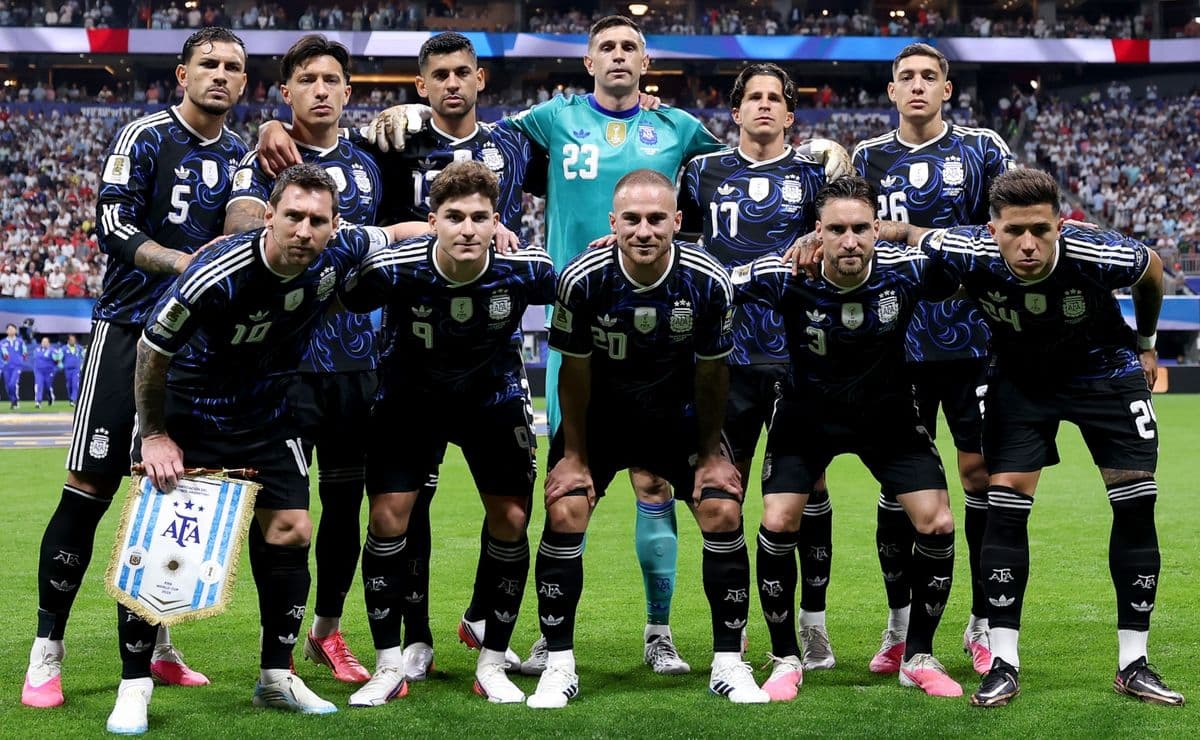
The continuity has been a huge reason for the 2026 World Cup participation for Argentina as most of their players were present in Qatar. The final of the 2026 World Cup has Argentina and Spain as the last teams remaining in the competition, making it Argentina’s second consecutive appearance after beating France in Qatar. While the team has many strengths, continuity may be the main reason Argentina are once again where they are. Helped by a squad that had already gone through a renewal process, most of the same players remain and have continued to deliver strong performances. From the team that won the title four years ago, 17 players are still part of the squad. Gerónimo Rulli, Emiliano Martínez, Nicolás Tagliafico, Gonzalo Montiel, Cristian Romero, Nicolás Otamendi, Lisandro Martínez, Nahuel Molina, Leandro Paredes, Rodrigo De Paul, Exequiel Palacios, Thiago Almada, Alexis Mac Allister, Enzo Fernández, Julián Álvarez, Lionel Messi and Lautaro Martínez are the players who were selected for both squads. The 2026 team Goalkeepers: Juan Musso, Gerónimo Rulli, and Emiliano Martínez. The team of the final (Clive Brunskill/Getty Images) Defenders: Marcos Senesi, Nicolás Tagliafico, Gonzalo Montiel, Lisandro Martínez, Cristian Romero, Nicolás Otamendi, Facundo Medina, and Nahuel Molina. Midfielders: Leandro Paredes, Rodrigo De Paul, Valentín Barco, Giovani Lo Celso, Exequiel Palacios, Nicolás González, Alexis Mac Allister, and Enzo Fernández. Forwards: Julián Álvarez, Lionel Messi, Thiago Almada, Giuliano Simeone, Nico Paz, José Manuel López, and Lautaro Martínez. The 2022 team Goalkeepers: Franco Armani, Gerónimo Rulli, and Emiliano Martínez. Defenders: Juan Foyth, Nicolás Tagliafico, Gonzalo Montiel, Germán Pezzella, Cristian Romero, Nicolás Otamendi, Lisandro Martínez, Nahuel Molina, and Marcos Acuña. Midfielders: Leandro Paredes, Rodrigo De Paul, Ángel Di María, Exequiel Palacios, Thiago Almada, Alejandro Gómez, Guido Rodríguez, Alexis Mac Allister, and Enzo Fernández. Forwards: Julián Álvarez, Lionel Messi, Ángel Correa, Paulo Dybala, and Lautaro Martínez.

Let's take a closer look at the knockout scenarios and how the ultimate victor will impact the rest of the 2026 World Cup bracket. In one of the most fascinating Round of 32 matchups of the 2026 World Cup, defending champion Argentina takes on history-making debutant Cape Verde. This decisive, win-or-go-home clash in Miami will see Lionel Messi face off against a resilient underdog that has already proven it belongs on the global stage. Let’s take a closer look at the knockout scenarios and how the ultimate victor will impact the rest of the 2026 World Cup bracket. Argentina has looked every bit like a defending champion during the group stage, winning all three matches while scoring freely and remaining solid defensively. Lionel Scaloni’s side has extended an impressive winning streak, with Messi once again leading the way after producing six goals during the tournament. Cape Verde, meanwhile, has written one of the greatest stories of the competition. The African nation reached the knockout stage in its first-ever World Cup appearance, becoming the first debutant since Slovakia in 2010 to achieve that feat after earning draws against Spain, Uruguay and Saudi Arabia. The Blue Sharks have demonstrated remarkable tactical flexibility throughout the tournament. Whether defending deep against stronger opponents or pressing higher up the field, Bubista’s side has shown discipline, organization, and resilience that few expected before the competition began. PosTeamW-D-LGDPtsStatus1.Argentina3-0-0+79Advanced2.Austria1-1-104Advanced3.Algeria1-1-1-24Eliminated4.Jordan0-0-3-50Eliminated At 39 years old, Lionel Messi continues to perform at an extraordinary level. The Inter Miami star has already scored six goals at this World Cup and has now found the net in seven consecutive World Cup matches dating back to Qatar 2022. PosTeamW-D-LGDPtsStatus1.Spain2-1-0+57Advanced2.Cabo Verde0-3-003Advanced3.Uruguay0-2-1-12Eliminated4.Saudi Arabia0-2-1-42Eliminated What happens if Argentina wins and Cape Verde loses? Should Argentina defeat Cape Verde, whether in normal time, extra time, or on penalties, the defending champion would move into the Round of 16 to face the winner of Australia versus Egypt. Lionel Messi of Argentina celebrates after scoring against Austria. That outcome would keep Scaloni’s men firmly on course for another deep tournament run. With Messi enjoying outstanding form and the squad playing confidently, Argentina would remain one of the strongest contenders to lift the trophy once again. For Cape Verde, defeat would still represent the end of an unforgettable campaign. Reaching the knockout rounds in a debut World Cup appearance has already secured the nation’s place among the tournament’s biggest success stories. What happens if the match is level after 90 minutes? A draw after regulation does not eliminate either side immediately. Instead, FIFA’s knockout rules require the teams to play 30 minutes of extra time, divided into two 15-minute periods. Giovani Lo Celso #11 of Argentina celebrates with teammates after scoring against Jordan. If neither side can find a winner during extra time, the contest proceeds to a penalty shootout, where one nation advances and the other is eliminated. Regardless of how the winner emerges, the successful team will occupy the same place in the Round of 16 bracket against Australia or Egypt. What happens if Cape Verde wins and Argentina loses? A Cape Verde victory would rank among the greatest upsets in World Cup history. Eliminating the defending champion would send the tournament debutant into the Round of 16 and dramatically alter the knockout landscape. Vozinha of Cape Verde. The Blue Sharks would inherit Argentina’s place in the bracket and continue their remarkable journey against either Australia or Egypt. Lionel Scaloni’s side, meanwhile, would suffer an early exit, ending its hopes of becoming the first nation since Brazil in 1962 to successfully defend the FIFA World Cup title.

While Lionel Messi is channeling the vast majority of Argentina's goals in the 2026 World Cup, head coach Lionel Scaloni remains unfazed by the lopsided production. Lionel Messi has once again emerged as the undeniable driving force for the Argentina national team during the 2026 World Cup, putting on an incredible goalscoring form that has completely eclipsed his teammates and reignited questions surrounding the squad’s perceived “Messi-dependency.” However, the Round of 32 clash against Cape Verde on the horizon, head coach Lionel Scaloni firmly stated that Messi’s lopsided dominance on the scoresheet is “not worrying.” Heading into the knockout stage, Argentina sits as the 10th-highest scoring team in the tournament with eight goals. However, a staggering six of those tallies belong to Messi, who currently co-leads the Golden Boot race alongside Kylian Mbappe, meaning the iconic captain has accounted for 75 percent of his team’s offensive output, a statistic that highlights his individual brilliance but also exposes a lack of clinical finishing from the rest of the Albiceleste roster. When questioned about Messi’s massive share of the scoring during Thursday’s press conference, Scaloni offered a defensive response: “Leo has scored goals, and we’ve had goalscoring situations from other players. Maybe he channels a lot more of it (Messi), but he is a forward for the team. We have had chances, regardless of whether or not we made the goalkeeper the man of the match—I think we’ve had chances. So it’s not worrying.” Argentina’s only other two goals of the tournament came during the World Cup group-stage finale against Jordan, a match Messi started on the substitutes’ bench since the top spot in the group had already been locked up. Notably, both of those goals were manufactured from dead-ball situations, with Giovani Lo Celso curling in a free kick and Lautaro Martinez converting a penalty, meaning no other Argentine player has found the back of the net from open play in this tournament. Giovani Lo Celso #11 of Argentina celebrates with teammates after scoring against Jordan. Nevertheless, the statistical imbalance remains a non-issue for Scaloni as his team transitions into single-elimination play: “We would love to distribute the goals across the whole team, but as long as things are going well, we win, and the team creates a baseline of chances, I think that is important to emphasize. The team creates chances, and Leo is, besides being a great player, the team’s forward, and along with Lautaro, Julian, or whoever happens to play, we will try to make sure they can score, and the others as well.“ No other knockout-bound heavyweight, including France with Mbappe, Norway with Erling Haaland, or England with Harry Kane, has channeled such a massive percentage of its goals through a single player. The true litmus test arrives on Friday, July 3rd, against Cape Verde at Hard Rock Stadium in Miami, where Messi will return to the starting XI and fans will see if this extreme reliance on his genius is a championship trait or a fatal flaw. Messi on the verge of reaching new heights Cape Verde pulled off one of the biggest surprises of the opening round, securing the second spot in Group H as heavy underdogs following shocking draws against powerhouse nations Spain and Uruguay, paired with a scoreless stalemate against Saudi Arabia. While they project to be a highly disciplined and stubborn defensive opponent, Messi will once again have a date with destiny in South Florida. Already cemented as the all-time leader in both World Cup appearances and goals scored in tournament history, simply stepping onto the pitch on Friday will mark Messi’s 30th career World Cup match. Furthermore, a single goal against Cape Verde would elevate his historical tournament scoring tally to 20, setting an unprecedented gold standard for two records that already bear his name.
Giovani Lo Celso has impressed for Real Betis, despite his injuries, and has no intentions of leaving the club for River Plate. The post Lo Celso ‘very happy’ to stay with Betis despite River Plate links appeared first on SoccerNews.
Lionel Messi extended his record as World Cup top goalscorer to 18 with a stunning free kick goal in Argentina's 3-1 win against Jordan. Argentina wrapped up its 2026 World Cup Group J campaign on Saturday, June 27th, against Jordan at Dallas Stadium. In a convincing 3-1 victory, Lionel Messi extended his historic tournament goal tally to 18 with a spectacular free-kick strike. With a knockout stage berth and the top spot in the group already locked up, La Albiceleste still pressed for a win from the opening whistle despite manager Lionel Scaloni deploying a heavily rotated lineup. Giovani Lo Celso opened the scoring with a brilliant free kick in the 19th minute, and Lautaro Martinez doubled the cushion from the penalty spot in the 31st. Though Mousa Al-Tamari pulled one back for Jordan in the 55th minute, marking the first goal Argentina conceded in the entire group stage, any hope of a comeback vanished when Messi subbed on in the 60th minute to dictate the tempo. In the 80th minute, after drawing a foul on the edge of the box, the Argentine captain stepped up to bury the free kick, sealing the 3-1 finale. The strike further cements Messi’s legacy as the World Cup’s all-time leading scorer with 18 goals, widening the gap over Miroslav Klose and Kylian Mbappe at 16. Furthermore, the 39-year-old maestro became the first player in soccer history to score in seven consecutive World Cup matches. LIONEL MESSI SCORES HIS 6TH GOAL OF THE 2026 FIFA WORLD CUP 🇦🇷Unreal from the 39-year-old legend. pic.twitter.com/C9CykSYene— FOX Sports (@FOXSports) June 28, 2026
After their two victories at the 2026 World Cup, Argentina have established as a top contender for the title. Excelling in attack, they appear set to secure first place in Group J. However, head coach Lionel Scaloni has decided to leave Alexis Mac Allister on the bench, surprising everyone Despite the uncertainties on their performances, Argentina have remained one of the best teams at the 2026 World Cup. Maintaining a highly attacking style of play, they have stayed unbeaten in the tournament and are the leaders of Group J. Despite the team’s excellent form, head coach Lionel Scaloni has surprised everyone by leaving Alexis Mac Allister on the bench for the final group-stage match against Jordan. Alexis Mac Allister is fully fit to play for Argentina vs. Jordan. However, head coach Lionel Scaloni has decided to leave him on the bench for tactical reasons and to give him some physical rest. With this in mind, he is expected to make a comeback for the Round of 32, as he remains a cornerstone of the midfield. With his passing ability and defensive consistency, he is one of the main reasons behind Argentina’s consistency in their play. Under Lionel Scaloni, Alexis has become one of the best players in the world. Although he is not a player who stands out statistically, he is the key behind the team’s ability to play out from the back and remain defensively solid. At 27 years old, Mac Allister is already one of Argentina’s regular starters, winning the 2022 World Cup, where he established in the starting lineup, and the 2024 Copa América, which saw Leandro Paredes move to the bench. Far from Lionel Scaloni’s decision being about underestimating Jordan, he is looking to manage the minutes of his biggest stars. With six points and a significant goal difference advantage, they have almost secured first place in Group J. After coming off a very demanding season at Liverpool, head coach is looking to manage the physical workload of Alexis Mac Allister so that he is in full physical condition for the 2026 World Cup knockout stage. Alexis Mac Allister #20 of Argentina being pressed by Ibrahim Maza #22 and Amine Gouiri #9 of Algeria. Who will take Alexis Mac Allister’s spot in Argentina vs Jordan? Argentina have decided to maintain their philosophy of play against Jordan: A high press and an attacking style. Despite the absence of Alexis Mac Allister from the starting lineup, head coach Lionel Scaloni is committed to maintaining strong control of possession. To do so, Leandro Paredes returns to the starting lineup. As one of the most experienced players in the squad, he could deliver a solid performance, having impressed in the minutes he has played. Alongside Paredes, Scaloni has decided to rely on Giovani Lo Celso and Exequiel Palacios in midfield, looking to maintain control of possession. With this, they move from a four-man midfield to a three-man midfield, representing a major tactical change. In addition, Nico Paz emerges as the attacking midfielder, looking to create spaces in the opposition’s defense. Therefore, Mac Allister’s absence may not be felt too much against Jordan.
Tap a headline to view metadata and excerpt fields in Sportra, then use the article website button to continue on the original publisher page.