Goal efficiency
How clinical and direct the player was in front of goal — volume, accuracy, and conversion.
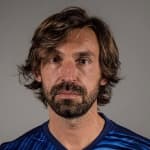
Confederations Cup · Midfielder · #0 · Italy · 39 yrs
Andrea Pirlo is a midfielder. Andrea Pirlo is a Italian international, 39 years old, midfielder. Andrea Pirlo was born in Flero, Italy on 1979-05-19. Andrea Pirlo is 175 cm cm tall and weighs 68 kg kg. Andrea Pirlo's Sportra profile tracks season statistics across Confederations Cup, World Cup, UEFA Champions League, Serie A. Andrea Pirlo's page brings together career clubs, trophies, injury history, multi-competition stats, and related news headlines. On Sportra you can explore Andrea Pirlo season statistics, transfer history, trophies, injury updates, and related news across every competition tracked in the profile.
Midfielder · #0
| Season | Team |
|---|---|
| 2016 |  Italy ITA Italy ITA |
| 2015 | Italy ITA |
| 2014 | Italy ITA |
| 2014 |  Juventus JUV Juventus JUV |
| 2013 | Italy ITA |
| Date | Type | From | To |
|---|---|---|---|
| 2015-07-08 | Free | Juventus JUV |  New York City FC New York City FC |
| 2011-07-01 | Free |  AC Milan MIL AC Milan MIL | Juventus JUV |
Season intelligence
Profile as Midfielder: high usage. Archetype: Box-to-box engine.
Scaled 0–99 from season output — map to fantasy, comparisons, or scouting cards.
Per-90 rates, efficiency ratios, and Sportra indices from season totals.
How clinical and direct the player was in front of goal — volume, accuracy, and conversion.
Playmaking output: assists, key passes, and custom chance-creation signals.
Minutes, availability, and how central they were to the team.
Every tracked category for this league and season, grouped by Sportra.

While addressing why he decided to step back from Italy's sporting director role after the president blocked Andrea Pirlo's signing, Paolo Maldini revealed that the money wasn't the reason why Pep Guardiola rejected the coach offer. Paolo Maldini was the central figure behind Italy‘s attempt to hire Pep Guardiola as the next manager of the Azzurri, though the Spanish tactician ultimately passed on the opportunity. While opening up about his departure from the Italian Football Federation (FIGC), the legendary defender explained why Guardiola chose not to take charge of the national team. In his former role as Italy‘s sporting director, Maldini was tasked by federation president Giovanni Malago with spearheading the search for a new head coach. While Carlo Ancelotti reaffirmed his commitment to Brazil, Guardiola, who had recently departed Manchester City, emerged as a viable candidate, leading to promising initial discussions. In an interview with Corriere della Sera, Maldini reflected on how negotiations with Guardiola unfolded: “He is the manager who most embodies technical, attacking play. Through a few mutual friends, he had expressed an interest in managing a national team. We went to visit him in Barcelona, had lunch together, and talked for an entire day. He was very tempted. He came very close to accepting. He even started writing line-ups down on paper.“ Maldini and technical advisor Leonardo traveled to Barcelona for face-to-face talks with Guardiola, who had recently stepped down after a decade at Manchester City. Although reports suggested Guardiola demanded a €20 million annual salary (roughly $22 million USD), Maldini clarified that money was never a barrier. “Financial terms were never an obstacle. Pep made it clear: give me one euro less than the previous manager, and I am satisfied,” Maldini revealed. Mikel Arteta (L), head coach of Arsenal, and Pep Guardiola (R), head coach of Manchester City. (Michael Regan/Getty Images) When asked about the deciding factor behind Guardiola’s refusal, Maldini was candid: “Out of fatigue. Guardiola is coming off ten grueling years in the Premier League. He had back surgery. He wants to rest. But it was a very serious discussion; we went over the rosters, from the under-17s on up… So we went with Andrea. Malago knew everything; we kept him informed step by step.“ Since making his top-flight managerial debut with FC Barcelona in 2008, Guardiola took a single sabbatical year between 2012 and 2013 before taking over at Bayern Munich, followed by a ten-year reign at Manchester City from 2016 to 2026. While managing a national team remained a career goal, the Spaniard ultimately decided the timing was not right to take the helm of the Azzurri. Maldini’s brief tenure and sudden resignation An institutional crisis following Italy’s third consecutive missed World Cup prompted Malago to appoint Maldini as sporting director. However, after assuming the role on July 11, Maldini resigned just 16 days later on July 27 after the federation president blocked the hiring of Andrea Pirlo over alleged ties between the former midfielder and a Russian betting firm. When asked whether those reported ties influenced the decision to override Pirlo’s appointment, Maldini defended his choice while addressing the controversy: “That definitely played a role. We didn’t know about it. The media did its job. But legally speaking, there was nothing that could have prevented Andrea from becoming the National Team head coach.“ Maldini emphasized that no legal impediments existed to block Pirlo’s appointment, arguing the situation was sensationalized beyond proportion. However, the disagreement prompted Malago to unilaterally alter the administrative structure, leading to an ultimatum that the AC Milan legend found unacceptable. “He (Malago) called me and Leonardo to say: ‘In my view, we can no longer hire Pirlo. From today on, I decide the manager. From today, the rules change: I choose the head coach, and you e

Despite being reached out with a juicy offer, Carlo Ancelotti revealed why he decided to stay at Brazil instead of turning into Italy's head coach. Carlo Ancelotti emerged as a primary target to fill the managerial vacancy on the Italy national team dugout following yet another shakeup within the FIGC (Italian Football Federation). However, the former Real Madrid boss ultimately decided to remain at the helm of the Brazil national team, opening up about his decision to pass on coaching his home country. Last week, Italy technical director Paolo Maldini confirmed during the search for a new head coach that Ancelotti manager was contacted alongside Pep Guardiola. “Guardiola? We can’t share any news; you have identified one of our targets, but we have also spoken with Ancelotti. It felt right to start with the best in the world, but we need to verify their overall availability,” Maldini said during a press conference with FIGC officials. Ultimately, Andrea Pirlo emerged as a top candidate for the role, but controversial ties to a Russian betting company led FIGC president Giovanni Malago to walk away from negotiations, a dispute that prompted Maldini’s resignation. Claudio Ranieri was subsequently named technical director, with Roberto Mancini selected as the new head coach, leaving Ancelotti firmly rooted in Brazil. Ancelotti’s reasons for turning down Italy After a legendary playing career, Ancelotti got his coaching start as an assistant for the Azzurri under Arrigo Sacchi from 1992 to 1995, reaching the 1994 World Cup final. After conquering domestic titles across all of Europe’s top five leagues, the 67-year-old manager had the opportunity to come full circle by taking over as Italy‘s head coach. Vinicius Junior #7 is consoled by Carlo Ancelotti, Head Coach of Brazil. (Buda Mendes/Getty Images) In an interview with ESPN’s Pedro Ivo Almeida, Ancelotti clarified his stance: “The truth is… why? Because it is not a contract issue, that’s not it. It is because I have a commitment to the CBF and to this country, because this country welcomed me so well during this first year. I want to continue here.“ While acknowledging the FIGC’s formal approach, Ancelotti reaffirmed his unwavering belief in the Brazil project. “And I obviously thanked the Italian Federation, but I want to stay here because I believe it is right and fair to stay in a country that welcomed me so well, at an institution that gave me the opportunity to work,” he stated. Ancelotti currently ranks as the highest-paid manager in international soccer, commanding an $11.3 million annual salary alongside perks such as private aviation access. The Italian federation reportedly prepared a comparable package, but neither a lucrative contract nor the pull of his homeland was enough to lure the former Real Madrid manager away from Brazil. Ancelotti remains under contract with the Brazilian Football Confederation (CBF) through June 2030 after extending his deal prior to the 2026 World Cup. The commitment ensures the Italian tactician will oversee the Selecao’s transition into the post-Neymar era, guiding the squad through CONMEBOL World Cup qualifiers, the 2028 Copa América, and ultimately the 2030 World Cup.
Tap a headline to view metadata and excerpt fields in Sportra, then use the article website button to continue on the original publisher page.
