Chance creation
Playmaking output: assists, key passes, and custom chance-creation signals.

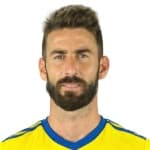
Segunda División · Midfielder · #6 · Spain · 37 yrs
José Mari is a midfielder. José Mari is a Spanish international, 37 years old, midfielder. José Mari wears shirt number 6. José Mari was born in Rota, Spain on 1987-12-06. José Mari is 180 cm cm tall and weighs 69 kg kg. José Mari's Sportra profile tracks season statistics across Segunda División, US Open Cup, Copa del Rey, Major League Soccer, and other leagues. José Mari's page brings together career clubs, trophies, injury history, multi-competition stats, and related news headlines. On Sportra you can explore José Mari season statistics, transfer history, trophies, injury updates, and related news across every competition tracked in the profile.
Midfielder · #6
| Date | Type | From | To |
|---|---|---|---|
| 2016-08-16 | Free |  Levante LEV Levante LEV |  Cadiz CAD Cadiz CAD |
| 2015-01-18 | Free |  Colorado Rapids COL Colorado Rapids COL | Levante LEV |
| 2014-03-04 | Free |  Zaragoza ZAR Zaragoza ZAR | Colorado Rapids COL |
Season intelligence
Profile as Midfielder: balanced output without a single dominant trait. Archetype: Balanced contributor.
Scaled 0–99 from season output — map to fantasy, comparisons, or scouting cards.
Per-90 rates, efficiency ratios, and Sportra indices from season totals.
Playmaking output: assists, key passes, and custom chance-creation signals.
Every tracked category for this league and season, grouped by Sportra.

With Marcelo Bielsa's resign after a disastrous 2026 World Cup, legend Diego Forlan is set to be appointed as next Uruguay's national team head coach Uruguay‘s 2026 World Cup campaign stands as one of the tournament’s biggest disappointments, ending in a shocking group-stage exit. With Marcelo Bielsa stepping down from the head coaching role, Diego Forlan is now set to take over and lead La Celeste into the next cycle. Tipped to challenge Spain for top spot in Group H, Uruguay’s campaign collapsed under the weight of a defeat to La Roja and back-to-back draws against Saudi Arabia and Cape Verde, with the latter one advancing as the second-placed team in the group. Following one of the most stunning early exits in recent Uruguayan football history, Bielsa announced his resignation at a lengthy press conference, leaving the position open. Uruguay Football Federation president Ignacio Alonso confirmed the development in an interview with Teledoce: “If an agreement is reached with Diego Forlan in the coming hours, he will be the coach of the Under-20 national team and for the upcoming friendly matches. He is enthusiastic, although there are still a few details left to finalize.“ The original plan had been for Forlan to take charge of the Uruguay Under-20 side ahead of the South American Championship in January 2027. With AUF elections scheduled for later this year, however, committing to a long-term senior project was not a viable option for either party. Jose Maria Gimenez of Uruguay shows dejection after the 0-1 defeat and elimination against Spain. Given those circumstances, Forlan will serve as interim head coach of the senior national team until March 2027. Whether the arrangement is extended beyond that point will depend entirely on the AUF and whoever holds the federation presidency following the elections. Within that window, Forlan, Uruguay’s third all-time leading scorer with 36 goals and an icon of the country’s memorable 2010 World Cup run, will oversee the September, October, and November international windows, which include 2030 World Cup qualifying fixtures, as well as March 2027 friendlies. In total, the former Manchester United and Villarreal forward will be in charge for eight matches. Forlan on Uruguay’s World Cup Heading into the World Cup, the expectation was that Spain and Uruguay would battle it out for top spot in Group H, with second place likely leading to a Round of 32 clash against Argentina. Instead, just two points from three games sent La Celeste home without even qualifying as one of the best third-placed nations. Forlan has had two previous spells in senior management, taking charge of 11 matches at Peñarol in 2020 and 12 at Atenas de San Carlos in the Uruguayan Second Division in 2021. But when asked about replacing Bielsa during an appearance on La Casa del Kun, the ESPN show hosted by Sergio Agüero, the former forward did not hesitate: “Sure, of course I’d go. Do you have any idea how fast I’d accept?“ Beyond his eagerness to take the job, Forlan was candid about the state of the national team, suggesting the problems ran deeper than the tournament itself: “I prefer a Uruguayan coach, because we have them, although I didn’t dislike the choice of Bielsa. Given where we stand right now, it’s not the time to be tossing around names. Unfortunately, we were already coming in with internal problems; we didn’t arrive in the best shape.”

Heading to the 2026 World Cup game against Cape Verde, Uruguay has already suffered a hit in the FIFA Rankings. Uruguay dropped in the live FIFA world rankings following a frustrating 1-1 draw against Saudi Arabia to open their 2026 World Cup campaign. Heading into Sunday’s match against Cape Verde at Miami Stadium, La Celeste needs a victory to jumpstart their tournament run and rebuild their ranking points. Uruguay currently sits in 18th place in the FIFA Ranking live projections with 1661.95 points. Marcelo Bielsa’s squad entered the tournament in 16th place with 1673 points, but the opening stalemate against the Saudis triggered an immediate slide in the live tracking. While historically a South American powerhouse, Uruguay is far from its all-time peak of second place achieved back in 2012. The team currently ranks as the fourth-best CONMEBOL nation behind Argentina, Brazil, and Colombia, while also trailing the USMNT (13th) when looking across the Americas. Uruguay remains the paper favorite in Group H despite the opening stumble. Powerhouse Spain leads the section in third place globally following a 4-0 win over Saudi Arabia, while the Saudis sit 61st and World Cup debutants Cape Verde trail at 67th. Maxi Araujo #20 of Uruguay celebrates with teammate Jose Maria Gimenez. A loss on Sunday would severely damage Uruguay’s knockout stage hopes and tank their official ranking position. On the bright side, La Celeste has never lost a World Cup match to an African nation, carrying an all-time record of three wins and two draws into the fixture. Uruguay looking to break back into Top 10 Uruguay has steadily lost ground to rival nations since winning their last major trophy at the 2011 Copa America. Despite boasting world-class talent like Federico Valverde, Ronald Araujo, and Jose Maria Gimenez, the federation needs a deep tournament run to break back into the global elite. The national team last cracked the top 10 in May 2021, when they briefly held the ninth position. They fell to 13th later that summer and have frequently hovered in 11th place without officially crossing the top-10 threshold.
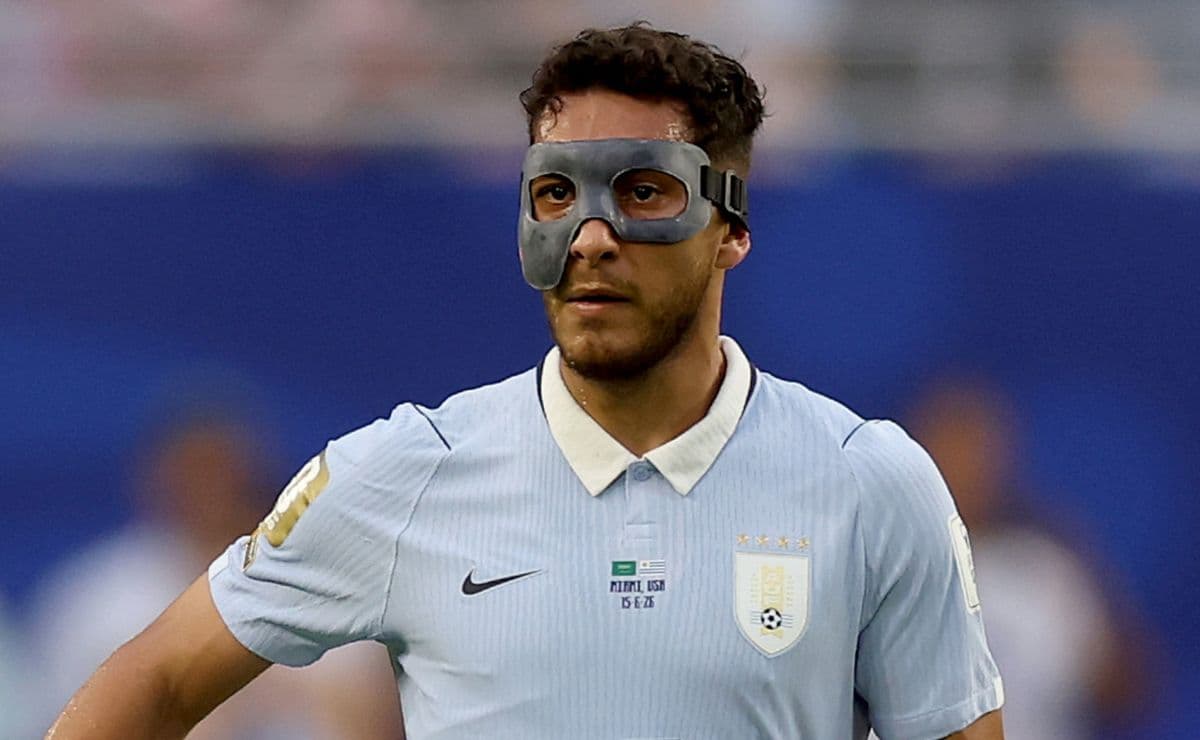
Sebastian Caceres is one of the multiple stars in the 2026 World Cup that's using a protective mask, in this case in the Uruguay game against Cape Verde. Sebastian Caceres will anchor the backline for Uruguay on Sunday as the primary center-back tasked with neutralizing Cape Verde’s attack during this highly anticipated 2026 World Cup Group H clash at Hard Rock Stadium. However, much like a handful of other prominent stars competing in North America, the defender has drawn some buzz for playing through the tournament with a specialized protective face mask. Caceres is required to wear the custom facial armor due to a severe injury he sustained in May while playing for Liga MX Club America during the domestic playoff quarterfinals. Contesting a 50-50 aerial ball against Pumas UNAM, the center-back was forced to exit the match in the 61st minute, ultimately sidelining him for the second leg as America was eliminated from the tournament. Club America medical staff issued an emergency diagnostic update shortly after the match, revealing that the collision had resulted in a concussion, a fractured zygomatic arch, and direct ocular trauma. The multi-layered facial fracture required immediate intervention from specialists, throwing his availability into serious doubt just as Uruguay manager Marcelo Bielsa was finalizing his preliminary World Cup roster. Fortunately, following an intensive, specialized rehabilitation process, Caceres managed to regain full physical fitness just in time to join the national team camp in the United States. To safely take the pitch, he must wear a protective mask featuring an extended right-cheek guard, a necessary precaution designed to stabilize the underlying bone structure and shield the healing area from any secondary impacts. Sebastian Caceres #3 of Uruguay reacts after the 1-1 draw against Saudi Arabia. Caceres, a cornerstone in Bielsa’s Uruguay Despite making his senior international debut in late 2022 and subsequently missing out on the final roster cut for Qatar, Caceres has rapidly transformed into one of Bielsa’s most trusted defensive cornerstones. The 26-year-old defender has already logged 24 career appearances for La Celeste, demonstrating exceptional positional awareness and gritty tactical discipline even though he has yet to record his first international goal. With Ronald Araujo sidelined from peak physical form and long-time captain Jose Maria Gimenez surprisingly dropped to the bench for the tournament opener against Saudi Arabia, Caceres has shouldered immense defensive responsibility. Partnering alongside Napoli’s versatile defender Mathias Olivera, the masked center back will feature his second World Cup game against Cape Verde.
Luis Suarez and Edinson Cavani are two of the biggest names that will be missing the 2026 Word Cup with Uruguay national team. Luis Suarez and Edinson Cavani have been the two defining strikers of Uruguay‘s golden generation in the 21st century, standing as the most prolific scorers in the nation’s history. Yet neither of them will be suiting up for La Celeste at the 2026 World Cup. Since Argentine coach Marcelo Bielsa took charge in 2023, he has been tasked with steering Uruguay through a generational transition ahead of and beyond the 2026 tournament. That process has involved a significant overhaul, leaving behind several figures from the squad that memorably reached the semifinals of the 2010 World Cup. In a striking reflection of that shift, Bielsa named only three forwards in his 26-man roster for North America, Darwin Nuñez, Federico Viñas and Rodrigo Aguirre, all natural center forwards capable of leading the line as a traditional striker. Why aren’t Suarez and Cavani at the 2026 World Cup? Both Suarez and Cavani are absent from the 2026 World Cup because they have each retired from international duty. Cavani’s final appearance for Uruguay came at the 2022 World Cup in Qatar, while Suarez played his last game in the national jersey in September 2024 against Paraguay. Luis Suarez and Edinson Cavani of Uruguay. Under Bielsa, Cavani was never called up once, while Suarez made his exit from international football a few months after the 2024 Copa América. Shortly after that farewell, the Inter Miami forward went public with his criticism of Bielsa, accusing the Argentine coach of fostering a negative atmosphere within the squad. In the months that followed, Suarez softened his stance and left open the possibility of accepting a call-up if Bielsa ever extended one. That call never came, and the 39-year-old will be watching from the stands as one more supporter cheering on La Celeste. Despite their absence, the legacies both forwards have built with Uruguay will endure for generations. Suarez stands as the all-time leading scorer in Uruguayan soccer history with 69 goals in 143 appearances, while Cavani sits in second place with 58 goals in 136 matches. Suarez and Cavani surpassed by Muslera in World Cup appearances While Suarez and Cavani have written their final chapters with the national team, goalkeeper Fernando Muslera has earned one last moment in the spotlight. His inclusion in the 2026 squad makes him the first Uruguayan player ever to appear at five different World Cups, moving ahead of a distinguished group that includes Suarez, Cavani, Diego Godin, Pedro Virgilio Rocha and Martin Caceres, all of whom reached four appearances. Atletico Madrid defender Jose Maria Gimenez, meanwhile, is set to make his fourth World Cup appearance with this edition, joining that same group. At 31, Gimenez still has a realistic shot at making the 2030 tournament and potentially joining Muslera in the five-edition club.
Tap a headline to view metadata and excerpt fields in Sportra, then use the article website button to continue on the original publisher page.